

Surabaya, Indonesia, 2009
Communicative Language Teaching (CLT), which emphasises language production, is most effective in small adult groups where learners have sufficient conversational skills and confidence. Its success depends on learners' maturity and willingness to share speaking time, a core objective of CLT approaches such as Task- and Project-Based Learning and PPP.
Communicative vs. Comprehensive Teaching Methods
Communicative Language Teaching (CLT) drove the rapid expansion of the TESOL industry in the 1980s, supported by European investment in language education, the growing use of English across Europe, and demand for teachers who could promote real-world communication.
However, implementing CLT in many Asian classrooms proved challenging. Teachers were often expected to apply a methodology designed for small groups of confident adult learners to large classes of younger students, where cultural norms such as avoiding public mistakes and reluctance to speak spontaneously could limit participation. This created challenges for both local teachers and foreign instructors trained primarily in the European CLT model.


For over 50 years, TEFL International has successfully used a comprehension-based approach across more than 40 locations worldwide. Drawing on Stephen Krashen's Natural Approach, learners first develop comprehension and confidence before progressing to communicative language use.
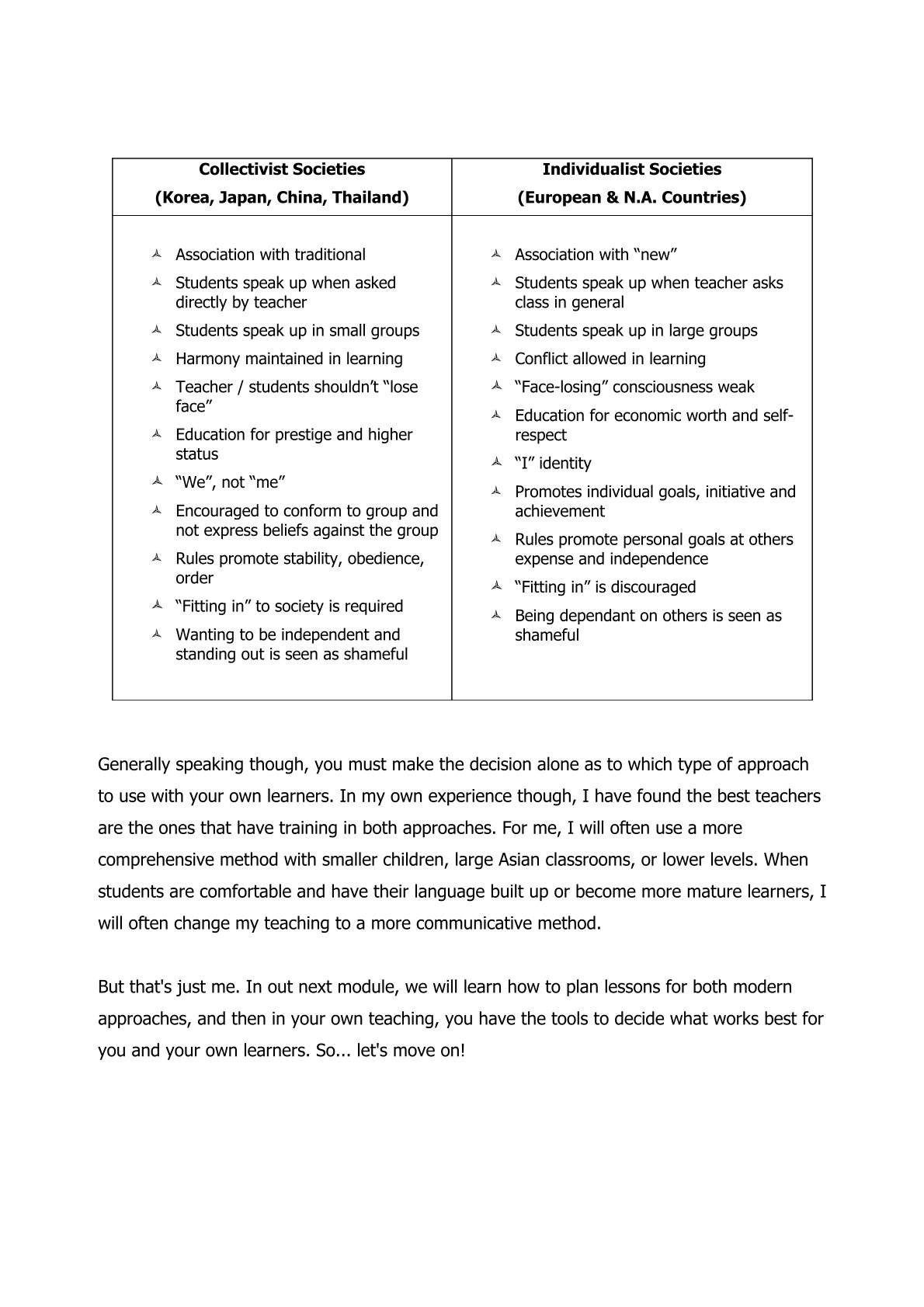
Researchers often distinguish between more individualistic and more collectivist societies. Many European and North American countries tend toward individualism, while many Asian countries tend toward collectivism, although these are broad cultural tendencies rather than fixed categories.
Communicative Language Teaching (CLT) encourages risk-taking, independent learning, discussion, and active participation. It is often most effective in smaller classes where learners are comfortable speaking and competing for interaction.
In contrast, a comprehension-based approach promotes collaboration, reduces the pressure to speak before learners are ready, and is easier to implement in large classes. By emphasizing comprehension before production, it can be particularly effective in educational settings influenced by Confucian traditions. In my experience, this approach has produced strong results in classrooms in Korea, China, and Thailand.
Nanjing, China, 2014


Zhongshan, China, 2013